
At Allegra, we believe that childhood is experienced through exploration and connection with the world around us. Our philosophy combines the autonomy, order, and hands-on learning of Montessori with the creativity, art, and music of Waldorf.
Waldorf art and music nurture each child's imagination and sensitivity.
In this way, we offer a holistic early childhood education that supports the child in body, mind, and heart.
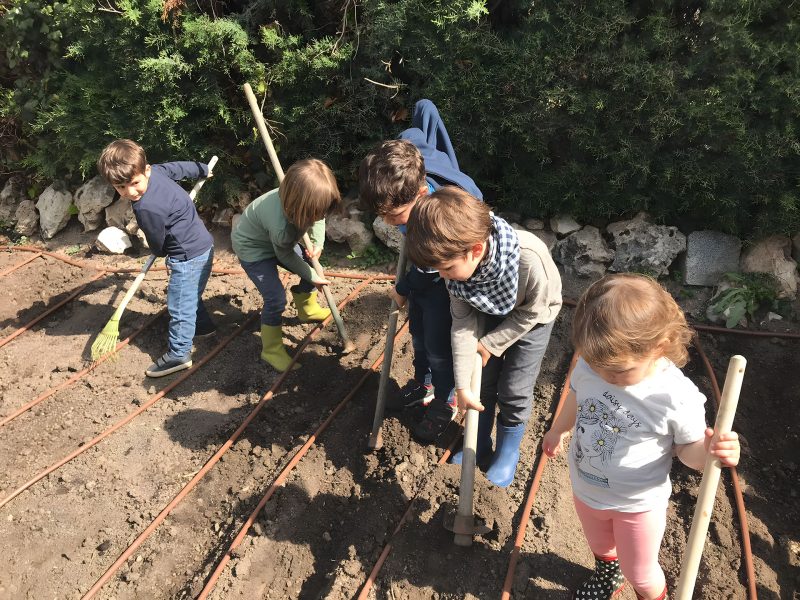
At Allegra, nature is our primary classroom. We play, discover, and learn outdoors every day, in contact with the sun, rain, wind, and earth. Working in the school garden and orchard fosters respect for the environment, patience, and responsibility, while planting and tending connects children to the natural cycles of life.
Montessori materials allow children to explore, experiment, and learn at their own pace, developing concentration, autonomy, and independence. All of this takes place within a bilingual environment, where English is naturally integrated into the daily routine, fostering experiential learning based on practice and experience.
Art and music inspired by Waldorf pedagogy nurture each child's imagination and sensitivity. We paint, sculpt, sing, and play instruments, fostering personal expression, creativity, and emotional balance. These experiences are harmoniously integrated into daily life alongside Montessori learning, offering a holistic, respectful, and meaningful education.
Our mission is to offer a respectful, warm and carefully prepared educational environment, where each child can develop at their own pace, preserving the essence of their childhood and cultivating their natural curiosity.
We accompany children from 0 to 6 years old in a process of integral growth —emotional, social, physical and cognitive— fostering autonomy, self-confidence and a love of learning.
Immersed in Waldorf and Montessori pedagogy, and in an international approach, we promote a conscious education, on the part of the entire educational community, that honors the evolutionary stages and prepares children to thrive in a diverse world with sensitivity, creativity and a sense of purpose.
We recognize the child as a complete being, worthy of respect, with his own times, needs and processes that must be protected by responsible adults and accompanied without haste.
We avoid overstimulation and rushing learning, allowing each child to reach their developmental milestones organically. We respect their natural impulses towards exploration, manipulation, and experimentation with themselves and their environment.
We care for the environment as an essential educational element: beautiful, orderly, simple, and connected to nature. Natural elements. No jarring elements. Materials that come from nature and have great value that is passed on to the children.
Play, movement, sensory integration, and practical life skills are the cornerstones of meaningful learning at these ages. At Allegra, we foster these moments and provide suitable spaces for them.
We foster the child's gradual independence, strengthening their self-esteem and decision-making abilities. From a young age, we observe their interests and provide everything they need to become more autonomous each day. This begins with the physical, but it has a profound impact on the child's inner life, laying the foundation for their emotional well-being, values, and self-concept.
We prioritize safe, caring, and consistent relationships where children feel seen, heard, and supported. We guide them in acquiring the tools to manage conflicts and resolve them in a way that prioritizes their own well-being and that of others. In this way, we support and strengthen the development of empathy.
We integrate daily contact with the natural environment as a foundation for healthy development and respect for the world. Contact with nature helps us develop and connect with our own inner nature. That's why we feel a great sense of well-being when we are in contact with it and can experience it with closeness and trust.
We build an educational community where family and school work together in harmony and mutual respect. We support families with individualized guidance whenever they need it, or whenever we need it ourselves, closely monitoring the developmental changes of the children.
We prepare children for a global context, fostering curiosity about other cultures and an open and inclusive mindset.
He is perceived as capable, valuable, and with a solid foundation of self-esteem.
She has developed practical life skills and makes small decisions with an emerging awareness.
He retains his natural desire to explore, discover, and understand the world. His enthusiasm for learning drives him to want to discover the world.
They recognize and express their emotions appropriately and show empathy towards others. They are able to spend time in touch with themselves and identify most of their emotions.
They relate to others with respect, cooperation, and active listening. They are able to stop and truly see others.
He has cultivated his capacity for symbolic play, artistic expression, and flexible thinking.
It has developed coordination, conscious movement and connection with its physical environment.
The body explores and learns when the child can move at their own pace.
Integrated sensory development facilitates physical, social, and emotional learning.
In a safe and warm environment, spontaneous play is the basis of learning.
Through artistic materials and free projects, the child expresses and discovers his inner world.
Stories promote creativity, conflict resolution, and symbolic expression.
The vegetable garden, flower garden, and animals are spaces for learning and connecting with the rhythms of life.
Classrooms with more than one age group promote social learning and peer support.
Values such as warmth, patience, generosity, and empathy are reinforced.
Logic and mathematics are part of everyday life without academic pressure.
Space, time and freedom for the child to do things for himself.
The adult accompanies with conscious attention, serving as an example and guide.
Toys and natural resources that encourage experimentation and active expression.
An orderly and welcoming environment promotes safety, confidence, and well-being.
Small groups for more personalized attention.